
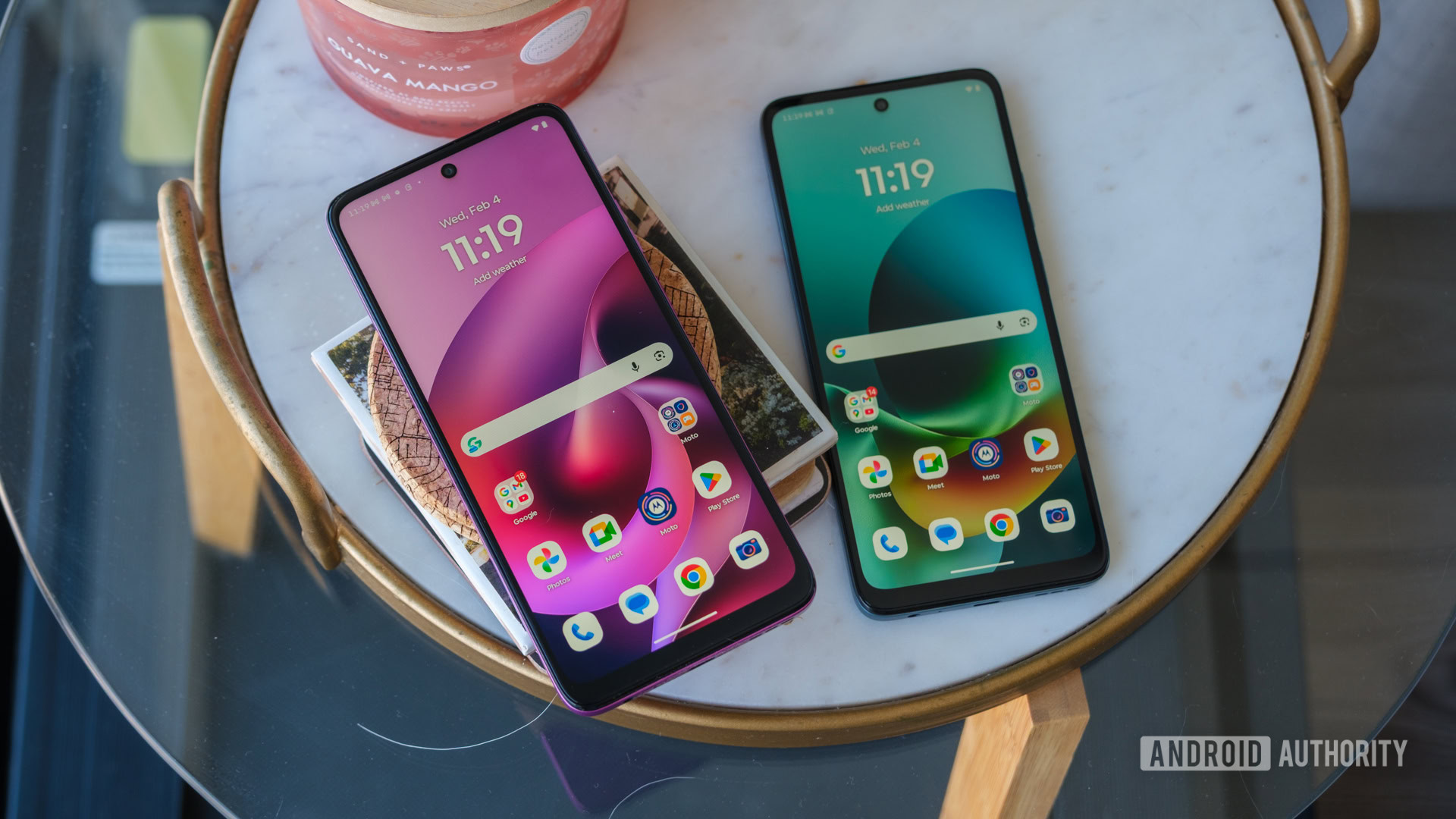
The Moto G (2026) is a little bit better than the Moto G Play (2026), but the bar is pretty low. While it adds a second rear camera, it doesn’t benefit from an updated chipset, and it still suffers from limited durability and a poor update commitment that will probably have you researching your next phone within a year or two.
Back in the day, each of Motorola’s cheap phones had its own identity. Each one had a slightly different design, chipset, and cameras, all of which made their price points feel justified. And even though I’d review one after the next after the next, I always found something to praise for those Android users living with a pretty limited budget.
Now, though, I feel like Motorola’s strategy makes no sense. After spending time with both the $169 Moto G Play (2026) and the $199 Moto G (2026), I don’t know why anyone would pick from the very bottom of Motorola’s barrel. Although they’re some of the cheapest phones that money can buy, there’s no doubt in my mind that it’s time to reach higher, and here’s why.
Pointing Spider-Man meme? Pointing Spider-Man meme.

Ryan Haines / Android Authority
I’ve spent a generation or two praising Motorola for making its budget-friendly phones look interesting. I gave it plenty of credit when it added colorful Pantone-based vegan leathers to Moto G devices from the top of the price range down to the bottom, and I stand by that. Its cheap Android phones still look better than the glossy plastic options that have come out of Samsung in recent years.
However, there comes a point when a little bit of overlap is a bit too much, and I think we’ve hit that. More specifically, here are the dimensions and weights for Motorola’s two cheapest phones:
- Phone A: 167.2 x 76.4 x 8.5mm (6.58 x 3.01 x 0.33 in), 202g (7.13 oz)
- Phone B: 167.2 x 76.4 x 8.5mm (6.58 x 3.01 x 0.33 in), 202g (7.13 oz)
They’re… the same. In hand, they feel the same. No matter what you’re using them for, they feel the same. It doesn’t even matter which one I call the Moto G Play (2026) and which one the Moto G (2026), because you won’t know the difference until I move on to the finer points of each design — literally just the cameras. By the way, before we keep going, the pink phone in this review is the Moto G (2026) while the blue-green one is the Moto G Play (2026), just to clear that up.

Ryan Haines / Android Authority
Seriously, though, on top of the matching heights and weights, these nearly identical twins also use the same materials. Whether you opt for the super-cheap Moto G Play (2026) or the also-very-cheap Moto G (2026), you’ll get a plastic frame, a vegan leather back, and a Gorilla Glass 3 display, which is the bare minimum Motorola could offer while still attaching the Gorilla Glass name. The fingerprint sensors in the power buttons are the same, too, which I’ll call a positive because they work just as well as they always have. At least both phones have an IP52 water-resistance rating, but that’s only for light splashes of water from a vertical angle (so, rain), and it won’t protect them much overall.
So, now it’s time to talk about the one thing that actually separates the Moto G Play (2026) from its slightly (and I really mean slightly) better Moto G (2026) counterpart. One of these phones has one camera, one has two, but both want you to think they have three. It’s a ridiculous design choice that makes the two look more capable than they are while also trying to make them both look like the Moto G Power (2026) — a phone that… oh, wait, still only has two cameras, but at least it has a better duo.
Motorola wants its cheap phones to look premium, even if that means using fake camera rings.
On one hand, I suppose I can understand how Motorola’s repeated design makes it cheaper to develop both phones. However, as recently as 2024, Motorola was perfectly happy to give its single- and dual-camera designs smaller camera bumps that looked just as good with vegan leather finishes, while only taking up the space they actually needed — no pretending to be bigger or more flexible to look slightly more premium.
If Motorola actually wanted its cheapest phones to look and feel better, it could have put an ultrawide camera on at least one of these phones, or upgraded some of the materials beyond the bare minimum. And yes, there is a headphone jack, which is nice, but it’s no longer enough to make up for the general lack of durability, and neither is the expandable storage via the microSD slot.
On the bright side, the display on both the Moto G Play (2026) and Moto G (2026) has a few decent specs. I like that its refresh rate tops out at 120Hz, and the 1,000 nits of peak brightness is alright in most conditions, but that’s about all there is to get excited about. Otherwise, it’s an LCD panel with a low 720p resolution that makes everything look fine but unremarkable. And, at the sub-$200 price point, I can’t say I’m surprised.
Just to make sure, though, I’ve run through just about the same list of videos, games, and social media scrolls on both devices. I’ve gone back to rewatch trailers for most of the episodes of Fallout’s second season, downloaded Pokémon Go while walking around during Baltimore’s biggest snowstorm in a decade, and scrolled through a nearly endless stream of people sledding, shoveling, and day-drinking because we’ve all been trapped inside for almost a week.
Overall, it’s looked fine. I wouldn’t want to watch an entire episode of Fallout, nor would I try to watch a movie (though I thought about it on my flight back from Florida with my family), simply because I’m not sure the resolution would keep up with darker scenes. I’d also hesitate to do too much gaming, not because it would look bad, but because I fear that Motorola’s cheapest phones suffer from a serious power vacuum. And yes, I did get Pokémon Go to run on both phones, but I felt like it took forever to start up, almost to the point where I was bored before I even started.
I can’t pick based on power anymore, either

Ryan Haines / Android Authority
Previously, you might have thought, “Shared designs are no big deal, I’ll just buy my phone based on its chipset.” For a while, that would have worked. Now, not so much. Once again, the Moto G Play (2026) and Moto G (2026) are pretty much identical. They both feature MediaTek’s Dimensity 6300 chipset (as does this year’s Moto G Power), 4GB of RAM, and expandable storage via microSD card slots. The Moto G has slightly more base storage, with 128GB over the Moto G Play’s 64GB, but that’s about it.
Perhaps the one positive I can actually draw from this shared chipset is that it brings 5G connectivity to the Moto G Play series for the very first time. I know it’s hard to believe that Motorola offered a budget phone without 5G as recently as 2024, but I guess that’s a sign that the Moto G Play’s year off in 2025 was for the best.
Of course, for every step forward, Motorola’s budget lineup also seems absolutely determined to take one step sideways. This time, it comes on the Moto G (2026). The previous version of that phone already had the Dimensity 6300 under the hood, which means it doesn’t actually get a meaningful upgrade under the hood outside of doubling the base storage. And, again, there’s a microSD slot on both of these phones, so extra base storage doesn’t really move the needle too much.
Anyway, since we already know there’s so much shared territory here, let’s put both of these cheap phones through our benchmarks to show just how identical they can be. As always, that means running the CPU and GPU through a set of pretty intense tests intended to separate the haves from the have-nots. Just don’t forget that we’re battling $200 devices, so there’s not a lot of, well, ‘have’ to be had.
As far as performance goes, the Moto G Play (2026) and Moto G (2026) are pretty much identical.
As you can see above, there’s not much to separate Motorola’s cheapest offerings. In fact, the Moto G Play (2026) and Moto G (2026) put up almost identical numbers to the Moto G from last year, with the former either matching or exceeding its scores by at least a hair. Interestingly, the Moto G Play (2026) also seems to come out just barely ahead of Motorola’s last generation, and it matches the more expensive Moto G Power (2026) in both multi-core Geekbench performance and the comprehensive PCMark test — again, shared chipsets and all.
Perhaps the bigger surprise with the 2026 Moto G lineup is how it compares to Samsung’s cheapest Galaxy A17 5G, which is the phone most people will likely be considering as an alternative to these phones. Despite Samsung’s in-house Exynos 1330 taking the lead in single-core Geekbench 6 performance, it is then surpassed by the entire Motorola lineup across both multi-core and PC Mark testing. There are, however, versions of the Galaxy A17 5G with up to 8GB of RAM, which may boost its performance numbers if you’re willing to pay extra.
I’m at least a little surprised by such a result, I have to admit. I figured that the Moto G Play would barely be able to handle its 4GB of RAM and upgraded chipset — after all, that’s what’s happened pretty much every time I’ve used the phone outside of my apartment. It takes forever and a day to launch apps like Pokémon TCG Pocket, and loading up Warhammer 40,000 Tacticus for the first time in a few months felt like I would never reach the point of active gameplay.
And, since we’re talking about gaming, I figure this is a good chance to flip over and show you perhaps the most identical set of benchmarks I’ve ever recorded. I’m no stranger to seeing cheap phones hold up pretty well during a stress test, but comparing recent Motorola launches to the Galaxy A17 5G takes it a step further.

Ryan Haines / Android Authority
They’re. All. Identical. There’s not really anything to separate one Moto G device from another, aside from maybe one or two runs here and there. The Moto G (2026) is a hair higher at first, and the 2025 model dips just once at around run number nine, but otherwise, they mirror each other all the way. Unfortunately, the Galaxy A17 5G sticks out like a sore thumb with its thin blue line below the rest, but the truth is that graphics performance across the board is about the same.
Simply put, I’d look elsewhere if you want to game. I’d look elsewhere if you want to multitask. I’d honestly recommend you find a deal through your carrier or bump up your budget if you want to do much with your next super-cheap phone, because Motorola’s inclusion of Perplexity and its weak, weak software promise don’t do much to elevate these underpowered phones.
I can’t keep using cheap phones that stumble through something as simple as opening an app.
And no, I know that I shouldn’t expect the world from dirt-cheap devices, but I feel as if Motorola is stooping below some invisible floor. If you want to tout your budget-friendly phones for supporting certain AI platforms, you have to give them at least the power to run properly. Right now, Perplexity lags for a good couple of minutes when I open it on either phone, which is enough time for me to either Google a question myself or move my more important research over to my laptop. The bar here is low, yet I’m still disappointed.
Perhaps the one thing that the Moto G Play (2026) and Moto G (2026) truly do well is offer bigger batteries than their closest competitors. Both phones pack matching 5,200mAh cells, jumping across the 5,000mAh barrier that’s so often seen as the limit for affordable, US-based phones. No, neither one has anything on the incredible capacities offered by Silicon-Carbon cells, but you’re not paying nearly as much, either.
And, when you set about trying to drain those batteries, you’ll find that Motorola’s cheap phones keep pretty good pace with their closest competitors.

Ryan Haines / Android Authority
Alright, so I mean it’s not ideal that the latest Moto G lineup doesn’t beat its 2025 competition across the board. It’s not great that it doesn’t consistently top Samsung’s cheapest phone, either. However, Motorola’s beefy batteries don’t get left behind, beating Samsung in our web browsing tests and putting up a good fight in 4K video playback. Unfortunately, though, Samsung’s smaller 5,000mAh cell outpaces Motorola’s whole lineup across the rest of our segments.
I’ve also noticed a bit of a hiccup when I’m not using the Moto G Play or the Moto G: passive battery drain. It’s not on par with Google’s old Pixels, but I charged up both cells one evening and found they’d dropped from 100% to an identical 70% by lunchtime the next day. If I’d been using both phones during that time, I don’t think I would have complained, but they’d sat there idly the entire time, making it pretty concerning to see such a drain.
Interestingly, the active drain on both phones doesn’t seem nearly as bad as the passive. I’ve been able to keep both phones away from chargers for more than a day, sometimes even two days, at a time. They barely sip power when you’re browsing the web or swiping through Instagram reels, working almost directly against what the just-okay battery results would suggest. And, when you do have to charge either cheap phone, at least you finally find one of their differences.

Ryan Haines / Android Authority
Yes, finally, a difference. The Moto G Play (2026) charges at a mere 18W, while its Moto G (2026) counterpart — and the previous Moto G — both reach 30W. You might not think it sounds like much, and it often doesn’t show up as a huge difference on paper due to thermal throttling, but in this case, the slightly more expensive phone will save you an entire hour of your day and roughly 20 minutes over the Galaxy A17 5G. That’s an almost unbelievable gap considering just how close these two phones are otherwise, but it’s true.
These days, I would call that a case of the Moto G (2026) keeping up with the times while the Play falls painfully behind. Not even Google’s slowest-charging Pixel 9a is that slow, raising the bar just a little bit to 23W. Perhaps the bright side is that the Moto G series doesn’t require any special charging technology. You could grab a USB PD PPS charger or one of our other fast favorites, but you’re mostly gearing up for your next upgrade by then. And no, there’s no wireless charging, though that’s not unexpected at this price tier.
Two cameras are better than one… I guess

Ryan Haines / Android Authority
Although there’s been very little — save for an extra hour on a charger — to separate the Moto G (2026) from the Moto G Play (2026), there’s a little more daylight when we take a longer look at their budget camera setups. I’ll stand by the fact that it’s silly for Motorola to put empty camera rings on the back of both phones, but at least there’s a tangible difference in the sensors inside the few occupied rings.
On the Moto G Play (2026), that means having a lone 32MP wide-angle sensor. It’s about as basic as it gets, offering a maximum aperture of ƒ/2.2 and video recording up to 1080p at 30 fps. There’s really not a whole lot else to say about it, other than maybe the fact that its individual pixels are slightly larger than those on the Moto G (2026), at 0.64µ compared to 0.61µ. While that might be good for light intake in low-light situations, it’s not a great look for long-range zoom, as you’ll see in a minute.
Otherwise, I have to give almost all the advantages to the Moto G (2026). It has a sharper 50MP primary sensor, a wider maximum aperture of ƒ/1.8, and actually has a secondary camera, albeit a dedicated 2MP macro shooter. Despite the slightly better flexibility, the Moto G (2026) offers the same set of just-okay video recording specs, so choosing between these two really comes down to what you can do with your still imagery and accepting that you’re capped at just 8x digital zoom.
And, as you could guess, that means it’s time to dig into some sample photos from each phone in hopes of picking out a winner.
Motorola Moto G Play (2026)
Motorola Moto G (2026)
Remember when I referenced the pointing Spider-Man meme above while talking about the designs of these two phones? Yeah, go ahead and copy and paste that whole thing down here. Unsurprisingly, the samples from both cameras are 90% the same, and that’s being conservative. The fields of view are identical, the level of detail is about the same despite the different resolutions, and the artificial bokeh from portrait mode matches, too.
Of course, I feel like I need to apologize for my samples leaning so heavily on reds and blues. As I said, we’ve had quite the snow this winter here in Baltimore, which means that everything has taken on one reflection or another as the city tries to find a way to dispose of its winter colors. As such, it all just looks redder or bluer than usual. Anyway, you can see that both phones have some of the same quirks, like the sky that’s much lighter towards the horizon over Brown’s Wharf. It’s not a bad look, just interesting given the otherwise consistent blue of the sky.
Also, I’ve noticed that the Moto G Play (2026) skews much warmer in its color recreation, a look that I personally prefer, though I know some may not. Here’s another set of samples for a slightly closer head-to-head look.
Once again, the Moto G Play’s results are warmer at both 2x and 4x zoom, and this time, I think the random bits of metal in the bird sculpture look just a little bit sharper from the cheaper phone. It may be due to slightly better light capture from the larger megapixels on a sunny day, but I’m not entirely sure. The difference isn’t huge, though, and I’m not sure it’s enough to outweigh the Moto G’s macro sensor.
Mentioning the macro sensor, I’d say it’s… fine. I mean, it’s a 2MP sensor, so I didn’t expect the world from it. Sometimes it’s pretty sharp, as in the case of the lightbulb to the right. I like the texture in the green bulb housing, and I like that both lights are in focus. Other times, though, the macro sensor struggles. Some bits of icy snow might be decently sharp, but it’s not a guarantee on the left, and trying to capture anything that can blow in the breeze is a challenge. I got lucky with the sprig in the middle, but it took a couple of tries.
Alright, let’s move on to some (very) limited zoom.
Moto G Play (2026)
Moto G (2026)
This time, there’s not a whole lot to separate the Moto G Play (2026) from the Moto G (2026). Both offer the same zoom ranges, topping out at a mere 8x digital zoom. Yes, the Play is once again just a bit brighter and maybe a hair warmer, but I don’t think that works in its favor this time. If you look at both 8x zoom samples, the Moto G’s result looks sharper and better-defined, thanks to slightly darker lines, especially on the side facing the sun. The Moto G Play, however, looks a bit washed out on the same side, and the sky is noticeably grainy — not something you’d expect on a cloudless day.
And now, for the final bit of comparison, the selfie cameras. Pretty much everything I’ve said above holds once again, though you might notice that the Moto G Play’s selfie camera frames my face much tighter. Its 8MP sensor is still warmer than the other, giving both samples a slightly more pleasing look, especially where the sun hits my jacket on my shoulder. Yes, it makes some details, like my zipper and the puffed-up panels, harder to see, but the gray is a bit more accurate.
The Moto G (2026), on the other hand, has a 32MP selfie camera with a wider field of view. It’s probably the better bet if you want to fit more people into your shot, especially if you bump out to the wider view, but I don’t love how cold the final images look, even if there’s a bit more visible detail on the front of my coat.
Neither of these phones can record 4K video, but the real kicker is the lack of 60fps at 1080p. Motorola’s video stabilization is actually pretty good, but I’m just not impressed with the smoothness.
If you want to check out full-resolution versions of these images (and more), you can do so at this Google Drive link.
I think it’s time to retire the Moto G Play and give the Moto G some love

Ryan Haines / Android Authority
After all this, you might sit here and think, “Hey, the Moto G Play sounds like a pretty good deal.” After all, it’s one of the few phones you can get for less than $200, and it does most of what Motorola’s next cheapest phone does. So, it’s probably worth buying, right? Well, I don’t really think so. On paper, it definitely looks that way, but in practice, the frustrations of using both of these phones have me itching to open my wallet just a bit wider.
And yes, I know that when you’re buying at this price point, you have to be willing to make concessions. However, both of these phones come with enough headaches that you’ll get much better value by picking up something just a bit more expensive. The Moto G Play (2026) has just one camera, agonizingly slow charging speeds, and base storage that’s barely useful without a microSD card. Oh, and its mere two years of Android updates falls sorely behind the likes of Samsung’s budget lineup.
Motorola’s budget phones should be better than this, and I’m sad they’re not.
Although the Moto G (2026) is a bit better, I still wouldn’t say it’s worthwhile. It didn’t get a chipset upgrade from the previous generation, its macro sensor is too inflexible for me to recommend, and its materials are still just fine. It feels more like a Moto G Play Plus while barely adding $20 of value. I’m disappointed that I didn’t like its camera results just a bit more, and I can’t get over the fact that Motorola added fake camera rings to make these phones look a bit fancier.
So, if you’re (wisely) considering something outside this Moto G duo, I have plenty of suggestions to offer. The first is that you try Motorola’s next step up in the Moto G Power (2026) ($299.99 at Amazon). That phone actually takes a step forward in terms of durability, packing IP68 and IP69 protection with a Gorilla Glass 7i display. It also charges at 30W, still has a headphone jack, and pairs its wide camera with an ultrawide sensor that you might actually use every once in a while. Unfortunately, its update commitment is still pretty modest, but at least you’re getting more of everything else for your money.
Samsung’s cheapest option adds a third camera to the mix (for real this time), offering wide, ultrawide, and macro coverage. Its charging speed is a bit slower than the Moto G and Moto G Power, but its software support more than makes up for it. You’ll get six years of updates out of this $200 device, carrying it through to the start of the next decade. Oh, and One UI is a bit more customizable than Hello UX, if you’re into that.
Mentioning customization, how can we not dig into the CMF Phone 2 Pro? It picks up where the Nothing sub-brand’s first attempt left off, offering modular accessories that let you tweak everything from your cameras to the color of your phone. It’s much more fun to set up than any other budget phone I’ve used, and Nothing OS is a design nerd’s dream. I love its clean, black-and-white simplicity, and its widget-based interface is so easy to navigate. Unfortunately, you’ll have to make sure the phone works with your carrier (especially in the US), but if it does, it’s absolutely the cheap phone to buy.
Thank you for being part of our community. Read our Comment Policy before posting.








Leave a Reply