
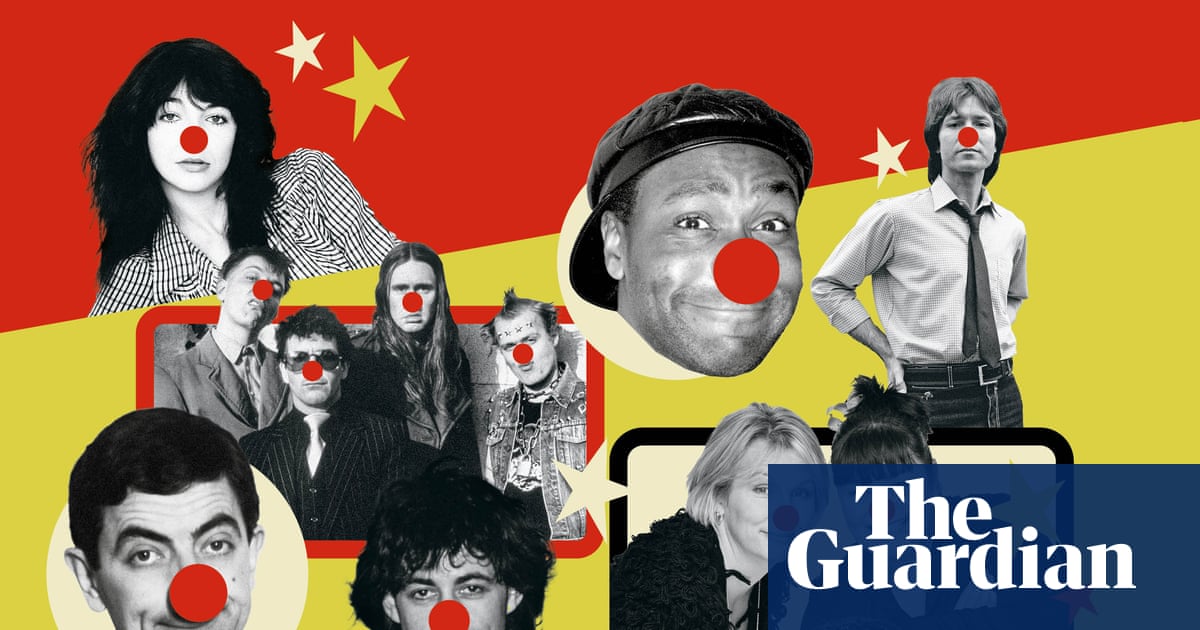
A near-the-knuckle Spitting Image skit involving the former prince Andrew. The Young Ones performing their chaotic single Living Doll with Cliff Richard. Kate Bush somehow being coaxed on to a stage to duet with Rowan Atkinson. It was 40 years ago this month that Comic Relief staged its inaugural event at London’s Shaftesbury theatre, and while today it is a fundraising juggernaut (the 2026 event, held last month, raised £30m for charity), its origin story remains delightfully scrappy and exploratory.
In 1984, a year before Live Aid entirely recalibrated what a showbiz charity event could look like, there was a remarkable gathering of what was fast becoming the new British comedy elite at a tiny village in Hampshire. The location, Nether Wallop, was chosen seemingly on the basis of its amusing name, and the intention was to create a comedy alternative to the Edinburgh festival.
But there was also a charity element to the Nether Wallop international arts festival. In fact, it introduced co-organiser Jane Tewson’s concept of “the golden pound” (the idea that every penny donated to a cause by the public should go directly to that cause, rather than being swallowed by administrative costs), which would soon become a foundational idea. But more than that it was, probably inadvertently, a test; establishing proof of concept.
It was also, clearly, a riot. Tewson, whose organisation Charity Projects would become fundamental to the story of Comic Relief, remembers a wild and windy day, “watching Bill Wyman playing on the stage with the Young Ones. I had not a contact in the world but we were fearless in calling the good and the great. And guess what? They came. The soprano Jessye Norman sang with the village choir. The Royal Ballet choreographer Lynn Seymour directed the local school ballet group. Jenny Agutter and Sir Michael Horden led the village pageant.”
Comedy producer John Lloyd, whose CV included Not the Nine O’Clock News, Blackadder and Spitting Image, recalls Nether Wallop as “honestly one of the greatest nights of my life”. His creative contribution was Mel Smith and Peter Cook playing synchronised swimmers on stage, wearing hats and nose clips. It’s easy to imagine how this might have played out in the context of such a hilariously ad hoc event. “They had to wait quite a long time before going on,” Lloyd says. “So they’d had a bit too much to drink.” Still, he doesn’t underestimate the event’s importance in terms of what was to come. “When you look at Nether Wallop,” he says, “you can see the skeleton of things forming.”
And so to Christmas 1985. Post-Live Aid and Band Aid – but still, sadly, with sub-Saharan Africa experiencing appalling need – Tewson bumped into a young comedy writer called Richard Curtis at a dinner, and told him she was planning to visit Sudan. He offered to accompany her but, after a meeting with Save the Children, found himself sent to Ethiopia on his own. It was a revelatory experience.
“I had a very complicated time in Ethiopia,” Curtis explains. “It wasn’t the peak of the famine but there were still big fields full of people, many of whom were very undernourished. There was one particular place where they had three huts, one of which was for people who would definitely not survive, one for people who might, and one for people who they hoped would. So I was amid the kind of images we’d seen on Live Aid.”
But the emotional impact was still more complex. “I had experiences that reminded me that laughter was still possible and not unnatural in these situations,” he says. “I saw a small child being weighed in a plastic nappy who was so undernourished that they slipped through the left leg. And I remember the people around them laughing, because it was a physically funny thing. They didn’t feel like they were in a situation where they had to sacrifice that side of their personalities.”
This insight directly inspired Comic Relief, as a means of both assisting the victims of famine in a practical sense and acknowledging their agency and humanity in a more universal way. Curtis and Tewson, who had quickly recruited comic Lenny Henry as a third founder, were clear that this had to be a collaborative effort, involving the people who the events were helping. As Lloyd puts it, “the combination of searing tragedy and comedy was such a clever idea. People up to that point had seen famine almost as a series of stick figures in a landscape. Suddenly, they were human beings with a family and a sense of humour.”
“Richard Curtis and I spent a lot of time talking about what we’d witnessed on TV,” recalls Henry. “Out of those conversations came the belief that comedy could bring people together and move them to act – not just laugh.”
Comic Relief’s first salvo was the Young Ones’ recording of Living Doll, with Cliff Richard. “I thought of the idea on one of the long, bumpy road journeys in Ethiopia,” says Curtis. “It was at No 1 for four weeks, even though it’s pretty cacophonous. It had a funny video, though. I seem to remember being in Cliff’s house at one point. He was very game and sang very well, unlike the rest of them.”
A live show was clearly the next step and, for practical reasons, the Shaftesbury theatre was an obvious venue. “We had access because Rowan [Atkinson] was doing his show there,” says Curtis. “So we used his set. We started at 10.30pm and as I recall, ended at 3am. We did these two long, remarkable, chaotic nights.”
Viewed from a modern perspective – the show was recorded for VHS and a BBC broadcast – the first Comic Relief is thrilling. From the brilliantly deadpan scatology of French and Saunders and the outrageous energy of Rik Mayall to the absurdist mastery of Billy Connolly, it’s a definitive snapshot of a particular era of British comedy, arguably at its pre-crossover peak. Charity may have been the intention, but it serves as a vital cultural document, too.
“It was a great laugh,” recalls Henry, of the first show. “And it shows how willingly the performers came together from the very start. The idea of helping people we don’t know and operating as though they were our neighbours across the street seemed to resonate. People wanted – and still do want – to help their neighbour wherever they are.”
“Billy [Connolly] was in his most amazing form,” says Curtis. “I remember it was 3am and I said to him: ‘Bill, you can do 15 minutes?’ And he said to me: ‘Ben Elton’s not going to do 40 minutes and me 15! I’m going to do exactly as long as I want!’ I don’t think anyone taking part was aware of the shape of the whole thing – not even me. It was just however many people we could throw on, for as long as they’d give us. Because it wasn’t live on television, with the rigour that, for example, Live Aid had to have, people – particularly standup comedians – felt free to roam. You didn’t have to say to people: ‘You’ve got seven minutes.’”
Just as Nether Wallop had encouraged its performers to create something new, rather than relying on highlights from their established routines, so Comic Relief offered a platform for a certain amount of risk-taking. In addition to Connolly’s habitually robust language (the TV broadcast apparently involved a series of awkward edits due to the sheer amount of swearing), it was clear Comic Relief offered a platform for a degree of experimentation. The direction of Paul Jackson (who also directed The Young Ones) was a sign of a willingness to embrace creative chaos. A glance at the lineup of the opening show (Stephen Fry performing a sketch with Midge Ure and Bob Geldof; boxer Frank Bruno attempting a scene from Romeo and Juliet with Lenny Henry) suggests that almost anything went.
Well, not quite anything. As Lloyd points out, the prevailing tone of what, at that time, was still just about regarded as “alternative comedy” was, in the language of the time, admirably politically correct. “We were quite progressive, so you’d be surprised how many things are still broadcastable,” he says. “It wasn’t racist or homophobic. Not even lightly so. So it was quite ahead of its time. The thing they would have struggled with at Comic Relief was not political stuff but matters of taste. Would it be too gruelling to put in something that made a point forcibly, but might make people turn off the telly? To get the segue right between a really moving film and a funny bit?”
Live Aid, of course, had evocatively mixed musical entertainment with frequent, often moving or harrowing reminders of why it had to exist in the first place. At the party after the first Comic Relief event, Curtis recalls a realisation that they were only at the beginning of something. “I remember having a conversation with Lenny and Dawn [French], where we said it was so strange that for fundraising, comedians had always done things in the theatre. Almost all of us were TV people, not theatre people. So we had the idea of trying to do what we’d done that night, but on the television.”
So, with the approval of the then controller of BBC One, Michael Grade, Comic Relief transitioned from live benefit show to telethon. Although even this process wasn’t straightforward. “Having put the money aside for Comic Relief, he [Grade] left his job about a month later,” Curtis recalls. “And he left no record of which pot of money it was meant to come from.” Live Aid had, of course, set a precedent. But this was a very different kind of high-wire act. Curtis was grateful for the help of veteran producer Michael Hurll (an overseer of everything from Top of the Pops to The Two Ronnies), who, he recalls, “found me drowning one day and offered to give me his wisdom”.
Once it had become apparent that Comic Relief was an idea with legs, a balance needed to be found between comedy and seriousness. Lenny Henry and Griff Rhys Jones were dispatched to Africa with Helen Fielding (who, pre-Bridget Jones, had been working as a researcher on Noel Edmonds’ Late Late Breakfast Show), given the job of directing short films from famine-affected areas.
It’s clear that taste issues were a constant consideration. “Lenny found a tone,” says Curtis, “which was very unpretentious, very humane and still, at times, funny. Which was a shock. There’s an extraordinary bit of film where he’s trying to do a piece to camera with an Ethiopian teenager and they both get the giggles and we left that in.”
“Comic Relief had a very grounded heartbeat,” says Tewson. “We relied on the people on the ground to inform and educate us. We were always listening to African people and giving them their own voice. But it was a challenging balance to achieve, and a constant conversation between all of us involved in the organisation.”
And so, the modern template for Comic Relief was born. It’s a mixture of irreverence and heart and in various, usually understated ways, a barometer of the culture that surrounds it. This means that inevitably, it occasionally intersects with more political battles. It hasn’t always avoided controversy: in 2019, a minor storm erupted around accusations (including from the current deputy prime minister David Lammy) of “white saviour” syndrome. Issues of representation are seemingly a constant consideration. “I have always had concerns about this,” says Tewson. “These issues are ever-present in my mind now as they were then; the idea that we know best, that we do things for people not with them and that we make decisions about things we don’t know enough about.”
“We’ve changed the way we tell stories,” Henry says. “Really putting the people we support right at the heart of everything we do. We’ve made huge progress in modernising our storytelling and films over the past few years – from working with local crews on international shoots to making sure people can share their experiences in their own words.”
The sense of changing times doesn’t only apply to political issues. With the decline of sketch shows, the content of Comic Relief has had to stay flexible, too. Curtis points to spoofs of shows such as The Traitors and film and TV parodies ranging from Mamma Mia! to Game of Thrones. But he suggests that, in purely creative terms, it remains an outlet for unusual combinations and ideas that wouldn’t fly in any other context. He recalls the duet between Steve Coogan (in character as Tony Ferrino) and Björk at the 1997 Comic Relief as a high point. “There are moments when people’s dream scenarios are allowed to happen because it’s for Comic Relief.”
This feels like a wistful callback to the earliest days of the enterprise with its odd combinations and sense of chaos. Comic Relief is an institution now, occupying large chunks of primetime, taken out of TV studios and into schools and sports clubs and, indeed, anywhere where a red nose might be worn and money might be raised. The notion that entertainment and awareness might be an awkward fit has disappeared. “There are very good-hearted people at the core of this,” says Lloyd. “Nobody is doing it as an opportunistic thing. Everyone is doing it for the love.”






Leave a Reply