
Mikel Arteta didn’t panic when failure appeared on the horizon again — instead he pressed the reset button.
When Arsenal’s Premier League title charge was teetering on the brink of collapse after the 2-1 defeat by Manchester City on April 19 — less than a month after the Carabao Cup final loss to the same opponents — the reaction inside their London Colney base was deliberately calm.
Arteta had been here time and again across the past three seasons as league runners-up, a perennial bridesmaid to his mentor Pep Guardiola. Those experiences had taught him that when crisis appears around the corner, rather than increase intensity, take a moment. Breathe. Over-analysis can be the bane of good results.
The players were given two days off. When they returned, the defeat was barely lingered on. There were no inquests, no heavy sessions. Instead, it’s understood that Arteta reset the mood entirely, breaking the squad into small teams for a light-hearted five-a-side tournament.
There was a barbecue for the first team and staff at London Colney in a bid to galvanise the team. A few laughs were shared, a conscious effort to rebuild energy and unity at a critical stage of the season.
It was these small but intentional moments, away from the cameras and chaos, that helped steady a squad under pressure as external noise grew louder. The nearly men of English football were finally ready to move from contenders to champions — and overcome the deep scars caused by Man City.
This is how Arteta ended Arsenal’s 22-year wait to win the Premier League title.

Arsenal’s title charge was teetering on the brink of collapse for the fourth season in a row after their 2-1 defeat by Manchester City on April 19

But Mikel Arteta did not panic – and instead hit the reset button to lead Arsenal to the Premier League title
Depth charge
Injuries were a sore point for Arteta last season, something he would privately bemoan for his team’s misfortunes. In the January 2025 transfer window, a reporter doubled down on the club’s need for a striker, with the Spaniard refusing to budge from his stock answer of ‘we are actively looking in the market’.
He held his irritation until the cameras switched off and made a beeline towards the culprit, fixing him with a death stare close up. The pressure had been bubbling — and now spilled over.
This season, Arsenal had a squad marked by its depth of talent, with the club adamant they would not repeat the same mistake twice. They bolstered the team across all areas with a £250million summer splurge — buying that elusive out-and-out No 9 in Viktor Gyokeres.
Having been hounded about purchasing a striker for the past two years, Arsenal had finally acted. The former Coventry frontman may have struggled initially but by the end of the campaign, his contributions had paid dividends for Arsenal through 14 league goals.
This deal, along with seven other signings including Martin Zubimendi and Noni Madueke, were the fruits of a new sporting director, Andrea Berta, who was appointed in March 2025 after Edu’s bombshell departure.
The day after Berta’s appointment, the Italian decided to greet the journalists at London Colney waiting for an Arteta press conference. Arteta arrived, silently waiting at the door as he quietly let Berta finish his interactions. Berta spotted the manager, they embraced, giggling, and he left the room. It was the first and last time we saw him around the base, but it was that sort of charm which won over insiders as he made his mark building this title-winning squad.
In the days after, he gifted bespoke red ties to executives ahead of the club’s Champions League quarter-final first leg against Real Madrid. The Gunners won 3-0, with staff in attendance wearing Berta’s red ties. They saw it as their ‘lucky’ item, so superstitiously wore it for the second leg at the Bernabeu where Arsenal won again to seal a semi-final spot.
The crucial benefit of the bounty that Berta’s first transfer window brought to Arsenal was evident when injuries bit hard again. Arsenal had six players injured for a Champions League match against Club Bruges in December, for example, but the Gunners were able to navigate their way to a comfortable 3-0 win, on their way to eight out of eight in the group phase.

Eberechi Eze was the crowning glory of Andrea Berta’s first transfer window, which gave Arteta the depth he craved

Berta (right) also sealed the deal to bring in a much-needed out-and-out No 9 in Viktor Gyokeres
Arsenal crave control and injuries were often things that they could not do anything about. So the safety blanket of the squad that Berta helped construct helped to smooth the bumps along the way. Not a perfect squad, by any stretch, but one ready for silverware.
Arteta had all the tools he had longed for: three defenders for each backline position, a midfield engine complemented by Euro 2024 winner Zubimendi, and a shiny new striker in Gyokeres. The times of Arsenal desperately using makeshift full backs, or Rob Holding stepping in for the injured William Saliba in a disastrous end to the 2022-23 campaign, or filling out the substitutes’ bench for a Champions League semi-final the season before with academy kids, were long gone.
Depth was no longer viewed as a luxury. It was considered essential infrastructure for a club attempting to compete across four fronts — and that was kickstarted by Berta.
But at the heart of Arsenal’s triumph were two figures who raised the team’s floor and ceiling. Declan Rice’s authority in midfield gave the Gunners control in the biggest moments, while David Raya’s catalogue of world-class stops saved them on umpteen occasions.
Rice and Raya became the building blocks of Arsenal’s title. One controlled the middle, the other controlled the moments behind it. Both ended up in the running for player of the season and without the pair, the title would likely have evaded Arsenal once again.
Psychological warfare
The Arsenal fanbase’s hunger for silverware had long since turned into anxiety — and this season, it began to properly bite.
The first real flashpoint came on January 25, a home defeat by Manchester United where boos were heard for the first time in earnest, as Arsenal made it three games without a win when Matheus Cunha struck the decisive goal for United seconds after Arsenal had made it 2-2.
By March, during a 2-1 win over Chelsea, there were audible groans despite the result. Then came the 2-1 home loss to Bournemouth last month, when Arsenal had an opportunity to go 12 points clear of City, where frustration fully seeped through and the boos loudly rang out at full time. It’s understood that players privately discussed the groans from the crowd. It was unavoidable.

A 2-1 home defeat by Bournemouth in April was met with loud boos at full time

Arsenal fans believed their title charge may have imploded for a fourth consecutive season
The day before the Cherries defeat, Arteta had told fans, ‘bring your lunch, bring your dinner… get there early’ — before his players served up dross to those in attendance. The manager caught further attention the following week with a bizarre monologue before a match against Sporting Lisbon.
‘No fear. Pure fire. That’s it. Me, the first one. Pure fire,’ he said. As the press conference went on, you sensed a man candidly seeking acceptance for his achievements at Arsenal. Taking them from 10th to second had been overlooked, in his eyes.
‘It’s the first time that we are three years in a row in the quarter-finals of the Champions League,’ he said. ‘You haven’t asked me any questions like, “Congratulations, you’re going to be in the Champions League next year”. Now it’s like we take it for granted. For other clubs, that’s the daily meal. For us, no.’
Sources say that during this period, Arteta would look more on edge than usual around the training ground. The pressure could no longer be hidden. Days later, Arsenal would lose at the Etihad and the title race was really back on.
But from here, a psychological switch occurred which changed the dynamics and set Arsenal’s campaign back on track. A source said from that point onwards, Arteta was keen to be more circumspect in his messaging to the fans. He felt conscious of the rising tension around expectations and the need to avoid fuelling it further.
There was also a renewed drive by Arsenal and Arteta to get the supporters on board by engaging with fan groups. For the Champions League quarter-final second leg against Sporting, the club invited a group of fans who had worked on a ‘tifo’ for the game to watch open training and meet Arteta and the players.
It’s understood that Arteta would give his thoughts on fan proposals to boost the Emirates atmosphere. Among them was the REDAction Gooners group idea to have a ‘greet the coach’ event for Arsenal’s Champions League semi-final second leg against Atletico Madrid; Arteta was said to be really enthused about the plan and passionately backed it.
Arguably the greatest atmosphere in the Emirates’ 20-year history followed as plumes of red smoke, flares and thousands of fans lined the streets hours before kick-off to create a cauldron. By reading the temperature of his squad, along with a sharp awareness of fan psychology, Arteta managed to steady the ship at a critical juncture.

Arsenal reached the Champions League final for the first time in 20 years after a euphoric victory over Atletico Madrid

It was arguably the greatest night in 20 years since the Emirates Stadium opened
Arteta’s Kingdom
When he arrived at Arsenal in December 2019, Arteta was a novice head coach inheriting a fractured environment. One of his biggest goals was not tactical — it was cultural.
The nuisances, like Pierre-Emerick Aubameyang, Mesut Ozil and Matteo Guendouzi, were quickly sifted out, with the leadership shifting towards younger players like Martin Odegaard and Bukayo Saka; the roots of the club had been cleaned. The players were fully moulded to Arteta’s vision.
Inside the training ground, the 44-year-old’s influence extended far beyond tactics. Departments that, at many clubs, operate with a degree of independence — nutrition and sports science, for example — would report to the manager. Staff presented their work, but the feedback loop was clear.
Arteta questioned, and then decided. To the outside, this looked dictatorial. On the inside, this was a man with a clear vision and for it to succeed, everything else had to be in sync.
He is an intense man. Standards are absolute; that is what makes Arteta tick. On one occasion, a familiar journalist was sitting across the room from where he traditionally did. As he asked a question, Arteta injected, pointing to his right and said: ‘You changed your seat.’
Amid all of this, there were lighter touches. He is a caring man, too. In a previous season when one staff member’s son was being bullied at school, Arteta invited him in to meet the players and train in the evenings.
When Raya was signed, he invited the family and had a custom shirt made for the goalkeeper’s grandfather. It is these touches which made this team want to fight to the end for him.
Overall, that is what sustained the culture he built. The foundations were unmistakable.

Departments that, at many clubs, operate with a degree of independence — nutrition and sports science, for example — would report to Arteta

His more left-field methods have been ridiculed but he has now delivered the title
Hunted vs Hunters
This wouldn’t be an Arsenal season without some slip-ups along the way.
There were two which cut particularly deep, the first being a 2-2 draw with Wolves in February. Raya and Gabriel were arguing heading to the tunnel after the final whistle, the flashpoint a defensive mix-up in the dying seconds that allowed Wolves to equalise.
The other was the Bournemouth defeat. The number of unforced errors made by the Gunners was astounding. Both losses had two things in common: mental capitulation, and a drop in levels. It was the hunter vs hunted dynamic. Arsenal didn’t like being hunted. They could feel the breath of City’s players on their necks.
In previous seasons, Pep Guardiola’s side were able to mount a string of wins together in the final months to get over the line, even when they didn’t look convincing before the new year. In the 2022-23 campaign, after having watched the Gunners sit top of the table for 248 days, City pounced when their rivals faltered; a run of 11 consecutive wins snatched the title.
A similar ruthless pattern was enjoyed in the 2023-24 season, winning nine on the bounce, to once again blow Arsenal away, despite the Gunners winning 16 of their final 18 games.
This time around, they failed time and again to capitalise on Arsenal’s faults. The Gunners’ defeats by Bournemouth and City in April were both opportune moments to capitalise.
Yet, they didn’t. Man City’s 3-3 draw at Everton was the clearest moment that this was not to be Guardiola’s season. Instead if was Arsenal who held their nerve, reeling off four consecutive victories without conceding after the defeat at the Etihad, as well as powering their way to a first Champions League final for 20 years.
This is a team hardened by previous heartache, ready to become champions. For this Arsenal side, the lessons were finally learned. And when the door opened this time, they didn’t hesitate.

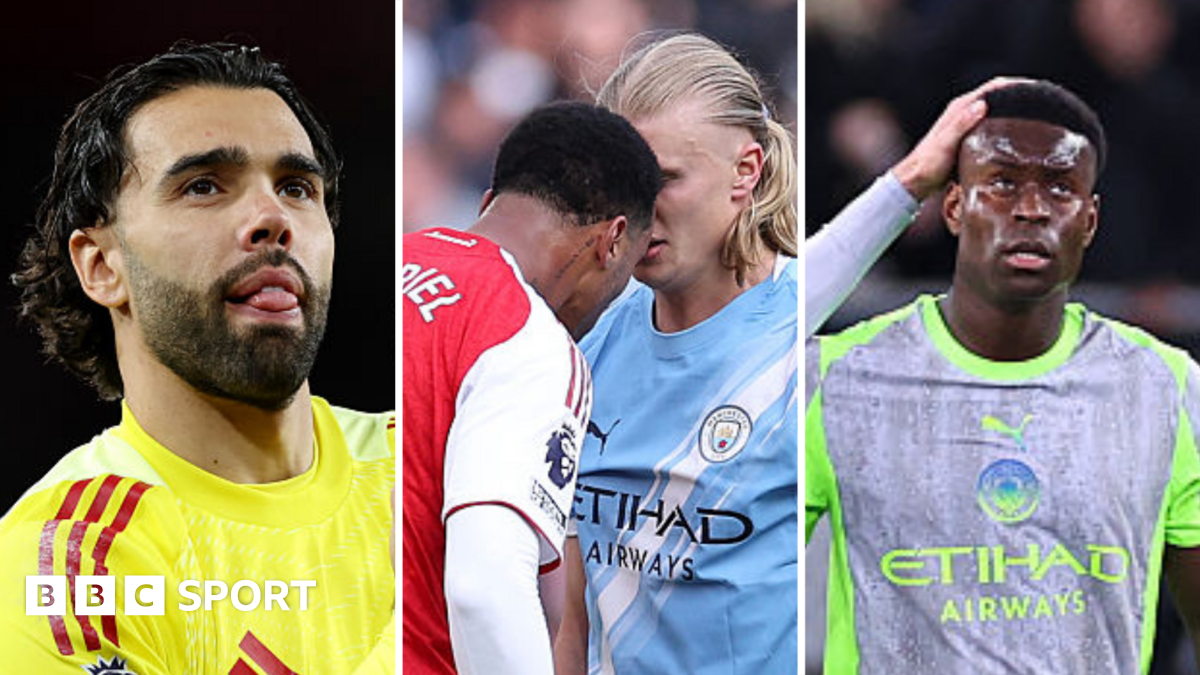
David Raya and Gabriel clashed after a humbling 2-2 draw at bottom club Wolves in February

But City could not capitalise on Arsenal’s nerves, and their 3-3 draw with Everton this month was the death knell for their own title charge
Kroenkes seize the moment
Seven years ago, Arsenal supporter groups had penned an open statement calling for owner Stan Kroenke to reinvigorate a club which had fallen by the wayside.
It puts into perspective the transformation to today. Son Josh Kroenke’s elevation to co-chair in March 2023 marked a more visible era for the Kroenke Sports & Entertainment (KSE) hierarchy at the club, which became increasingly notable this season.
Alongside the significant financial backing provided by KSE across the last three campaigns, there has also been a more hands-on sense of engagement from Josh himself. Insiders described a figure increasingly present around the football operation.
In November, during the weekend Arsenal faced Fulham, KSE’s NFL franchise the Los Angeles Rams were in London to play the Jacksonville Jaguars at Wembley. The executives from both organisations met to share ideas and explore operational approaches across sport.
Since taking on the co-chair role, Josh has maintained regular contact with Arteta and chief executive Richard Garlick. In some months, he’d visit London Colney multiple times.
It reflected his keenness to be around the club and ensure that their investment was paying dividends. And that hands-on approach helped ensure Arsenal were going only in one direction.
Set-piece success
Brighton’s Fabian Hurzeler would accuse Arsenal of ‘making their own rules’ when it comes to corners. Liverpool boss Arne Slot wasn’t a fan, either. Bernardo Silva, a chief irritant for Arsenal fans in recent years, indirectly had a dig at the ‘rugby’ tactics in an interview with Daily Mail Sport last week.
The numbers feed the narrative that Arsenal were too reliant on the method, but Arteta cared little, and the record books won’t show it either. The Gunners struck 24 league goals from set-pieces this season, more than any other Premier League team.

Kai Havertz nods in Arsenal’s 24th goal from a set-piece this season, to put the Gunners on the brink of winning the league with a 1-0 win over Burnley on Monday night

Declan Rice has been pivotal to Arsenal’s success from dead-ball situations
When Arsenal were struggling to break down opponents’ deep blocks, it was often a set-piece which paved the way to three points. Monday’s night 1-0 victory over Burnley was a case in point, Kai Havertz’s header off a Bukayo Saka corner making it 19 different Arsenal league games in which they had struck from a set-piece, not including penalties.
That equalled a joint-record by a team in a 38-game season. Extraordinary numbers. And while it will not be one of the prettiest styles of play from a champion in recent history, ultimately it got the Gunners over the line.
Set-piece guru Nicolas Jover has been the driving force behind that, convincing Arteta to make Rice Arsenal’s primary set-piece taker in January 2024. It has paid off enormously, particularly in the form of Jover’s set-piece goal bonus.
Football discourse will continue to debate whether Arsenal are worthy champions, but this is why teams slug it out over nine months and 38 games. To consistently grind out results across a campaign rejects the notion that the Gunners fluked their way to the top.
They had built upon their set-piece expertise from previous seasons and modified them further with new routines and utilisation of short corners.
The value Arteta places on set-pieces was reflected in a banner the club starting bringing to away changing rooms two years ago. It read ‘BASICS’. An acronym for Boxes, Attack, Shape, Intensity, Compete — and Set-pieces. How telling.

After 22 years, the waiting is finally over. Mikel Arteta’s Arsenal are Premier League champions
From contenders to champions
Arsenal did not win this title because they were flawless. They won it because, for the first time after three seasons of near-misses, they learned how to survive the moments that long defined their failures.
Where previous campaigns unravelled in key moments in the final months, this team absorbed them.
And in doing so, Arsenal finally stopped being contenders — and became champions. The 22-year wait is now over.







Leave a Reply