
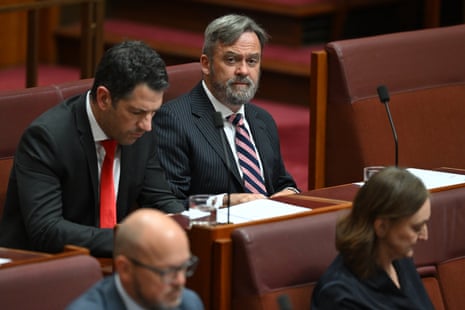
Liberal senator says Coalition’s migration policy ‘alienates’ migrants and ‘doesn’t meet the needs’ of the community
Liberal senator Andrew McLachlan said he has “deep concerns” the Coalition’s immigration policy will divide the nation, saying he doesn’t think the country should take a “negative approach to migration”.
McLachlan broke with opposition leader Angus Taylor, who said last week the nation should heavily restrict immigration, tying migration rates to the ongoing shortage of housing. The senator told RN Breakfast this morning:
I have deep concerns, coming from a multicultural community, that we are going to create two types of members in the community going forward with this policy suite. … If you’re both contributing to the wealth of the nation and one is entitled to certain entitlements, you could have almost a form of a strata-ing of our society. And I’m not sure that’s the Australian way.
McLachlan went on:
I don’t think our rhetoric meets the needs of the broader community. I think our rhetoric used alienates migrant communities. I don’t think we should take a negative approach to migration. Certainly it should be controlled and we don’t want to invite people here without giving them a society that can accommodate them. Both economically and culturally. But we cannot continue to blame migrants for the problems of our economy.

Key events

Melissa Davey
Lifeblood calls for urgent donations of A and O blood in Victoria
Australian Red Cross Lifeblood is urgently calling for 5,500 Victorians with A and O blood to donate within the next week as its blood supplies run very low.
Victoria needs more people to donate than anywhere else in the country. It is one of the most populated states, and demand is high after a long and intense 2025 winter saw people cancel donations due to cold and flu infections.
More donors are needed urgently to prevent Lifeblood’s stocks falling to critical levels by June, and to protect the blood supplies hospitals rely on for cancer treatment, surgery, trauma care and childbirth.
Lifeblood spokesperson Cath Stone said Type O and A blood are among the types most frequently ordered by hospitals.
“Winter is always a challenging time for blood donation,” she said.
When people are unwell with colds or flu, they can’t donate, even if they want to. But the need for blood doesn’t slow down. Patients undergoing cancer treatment, people needing surgery, and those injured in accidents rely on blood every single day.
To book a donation, call 13 14 95, or visit lifeblood.com.au
Butler says risk of Ebola to Australia ‘still low’, but officials monitoring situation very closely
Health minister Mark Butler said the Centre for Disease Control has been monitoring the ongoing Ebola outbreak in the Democratic Republican of the Congo and Uganda, which was declared a public health emergency of international concern this weekend.
The health minister said Australian officials had been working with the World Health Organization to monitor the spread of the virus, adding the chief health ministers of every state and territory met yesterday. Butler told RN this morning:
The risk to Australia is still low, but we’re monitoring it very closely because, first of all, the case numbers are increasing almost every day there. The number of deaths, as I think one of your reports said, is now over 100. And it’s a rare strain that’s not responsive to vaccines or treatments that we have. So we’re monitoring it very closely.
The minister added that the government would work with the Department of Foreign Affairs and the Border Force if needed to determine if any changes to travel advice were warranted.
Eleven Australians intercepted on global aid flotilla to Gaza

Caitlin Cassidy
Eleven Australians onboard a Global Sumud Flotilla that was attempting to transport humanitarian aid to Gaza have been intercepted off the coast of Cyprus.
According to a live tracker, 60 boats have been intercepted in recent hours, carrying hundreds of activists, including the Australians.
The Global Sumud Flotilla alleges those on board have been “illegally attacked” and “abducted” by the Israel Defense Forces (IDF), with footage posted to social media showing armed military boarding the boats. Guardian Australia has not independently verified these claims.
In a statement, the Flotilla said:
We are outraged by the normalization of these violations of international maritime law and the kidnapping of peaceful civilians in international waters. We demand the immediate release of our participants, the safe passage of our entire fleet, and an end to the illegal siege of Gaza.
Among the Australians onboard are five who were intercepted a fortnight ago by the IDF off the coast of Greece and temporarily detained.
The Israeli foreign ministry and the Israeli embassy have been approached for comment.
Queensland rescue crews helped 42 stranded students near the Gold Coast overnight
Brad Moore, coordinator with the Queensland State Fire Control Centre, said officials helped rescue 42 schoolchildren and their teachers trapped by flood waters near the Gold Coast last night.
Moore spoke to the ABC this morning, saying rescue crews undertook 15 rescues overnight, mostly around the Gold Coast area. The group of year 12 students and their teachers phoned in to get help after they were stranded and realised they couldn’t cross a dangerous area.
Moore said the rescue took some time, but they were able to safely transport the group around 9.30pm last night. He added:
The conditions can change quite quickly, particularly with the amount of rainfall … the water heights can change dramatically. …
It’s very important for people if they are in those areas or visiting those areas to kind of look ahead and plan the worst-case scenario.
Liberal senator says Coalition’s migration policy ‘alienates’ migrants and ‘doesn’t meet the needs’ of the community
Liberal senator Andrew McLachlan said he has “deep concerns” the Coalition’s immigration policy will divide the nation, saying he doesn’t think the country should take a “negative approach to migration”.
McLachlan broke with opposition leader Angus Taylor, who said last week the nation should heavily restrict immigration, tying migration rates to the ongoing shortage of housing. The senator told RN Breakfast this morning:
I have deep concerns, coming from a multicultural community, that we are going to create two types of members in the community going forward with this policy suite. … If you’re both contributing to the wealth of the nation and one is entitled to certain entitlements, you could have almost a form of a strata-ing of our society. And I’m not sure that’s the Australian way.
McLachlan went on:
I don’t think our rhetoric meets the needs of the broader community. I think our rhetoric used alienates migrant communities. I don’t think we should take a negative approach to migration. Certainly it should be controlled and we don’t want to invite people here without giving them a society that can accommodate them. Both economically and culturally. But we cannot continue to blame migrants for the problems of our economy.
More than $57bn of Victorian infrastructure at risk due to climate hazards

Petra Stock
More than $57bn of public infrastructure across Victoria will be at risk from extreme weather by 2030, with bushfires, flooding and heat posing the greatest threat, according to new research by Infrastructure Victoria.
The independent adviser assessed risks to $318bn in government-owned or regulated assets, finding that transport, energy and health assets were the most exposed to climate hazards. By 2070, the value at risk could increase to more than $71bn.
Dr Jonathan Spear, chief executive of Infrastructure Victoria said it highlighted the importance of climate resilient infrastructure.
Following a summer that saw bushfires, flooding and landslides hit many Victorian communities, we know extreme weather is a reality now.
The government needs to update and fund its adaptation plans. Funding high-priority, cost-effective infrastructure adaptation actions can save millions in recovery costs and lost productivity.
Erwin Jackson, the head of Australia programs at Climateworks Centre – who was not involved in the research – said:
The policies at a high level need to start integrating both reducing emissions and adaptation, but also focusing on the key risks, whether that be heat, bushfire, coastal inundation.
Part of the challenge was the scale of investment required to make infrastructure more resilient, he said. So, governments needed to identify the communities and assets that were most vulnerable, and work with the private sector to unlock investment in adaptation and resilience building.
Health minister acknowledges change to private health insurance rebates for seniors ‘unwelcome’ but says they are necessary
The health minister, Mark Butler, said he understands changes to private health insurance rebates for older Australians have left many seniors troubled, but said it was “difficult to sustain” a system that benefited people based on age, but not on income.
If legislated, the budget would remove subsidies that encourage people over 65 to take out private health insurance. Australians aged 65-69 would see their rebates cut from 28% to 24%, and those 70 and over would see their rebate cut from 32% to 24%. The savings would be funnelled back into aged care.
Butler said he understood it was an “unwelcome change”, but added:
We’ve taken this hard, but I think responsible decision to re-equalise, if you like, private health subsidies based on household income rather than household age, and putting every single dollar we save there back into aged care. …
I know it’s unwelcome to many, but at a time of real challenge in our budget and the need to find every dollar we can into aged care, we just took the view that where there are two households next door to each other on the same income, paying them a different subsidy for their private health insurance simply based on age was not sustainable.
Restricting welfare to citizens not ‘punishing’ but ‘incentivising’, shadow minister says

Josh Taylor
The shadow immigration minister, Jonno Duniam, has said Angus Taylor’s budget reply proposal to limit welfare payments only to Australian citizens was not a punishment for permanent residents but a “pro-migration policy” that would “incentivise that pathway to Australian citizenship”
ABC 7.30 host Sarah Ferguson asked Duniam how does “punishing tax-paying permanent residents appeal to would-be migrants that the country so badly needs?”
Duniam responded that “countless” people who have migrated to Australia and have become wealthy because of the opportunities have not been punished, and people like them who want to come won’t be punished either.
He said:
But they’ll still have to wait under the visa system a number of years, in almost all cases, to receive the kinds of welfare benefits that you are talking about.
And in many cases now, under Labor’s current approach, there are wait times between 4 and 10 years for various supports that people may want to take advantage of.
So this is not about punishment, but it is about trying to incentivise that pathway to Australian citizenship.
He said the Coalition is pro-migration, noting Australia’s ageing population, but says that “we want to determine who is coming here [and] in what number”:
We want to ensure that we have houses for them to live in.
And can I say, we want to preserve, for those who eventually become Australian citizens – which I hope is all of them that want to come here – the services that we provide in this country.
That’s a pretty pro-migration policy, if ever I’ve seen one.
But there will always be critics, and they will say what they say.
Good morning
Good morning, it’s Nick Visser here again to dive into this gloomy Tuesday, in Sydney at least. Here’s what’s on deck in the news:
More than $57bn of infrastructure in Victoria is at risk due to climate hazards, according a new study. An independent adviser assessed risks to government-owned or regulated assets, and found many were exposed to climate hazards. By 2070, the value could rise to more than $71bn.
A flood warning remains in place for the Nerang and Coomera Rivers in the Gold Coast after moderate to heavy rainfall in the region since Sunday night, and there are reports of flash flooding across roads. Rainfall is forecast to continue into Tuesday, with further river and creek level rises and flooding expected, according to the Bureau of Meteorology.
We’ll bring you more soon.







Leave a Reply