
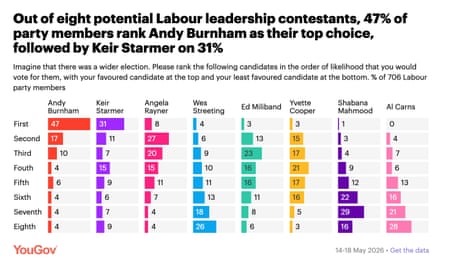
Labour members think party likely to win next election with Burnham as leader, but not Starmer, poll suggests
Good morning. A week ago, at cabinet, Keir Starmer delivered a “put up or shut up” message to his critics. Wes Streeting, his leading opponent, decided to do neither – declining to launch a leadership bid, but going public with his lack of confidence in the PM and resigning. And then Andy Burnham found a potential seat, meaning that, if Burnham can win the byelection, a leadership challenge has not been averted, just postponed.
We don’t have any byelection polling from Makerfield yet. But last night YouGov released some detailed polling on what Labour members think about the leadership which is worth flagging up because the views of members will influence the way events pan out in the weeks ahead.
Here are the main points.

When YouGov boiled it down to a choice between Starmer and Burnham, Burnham was ahead by a factor of 3 to 2.

-
Labour party members believe the party is likely to win the next election with Burnham as leader, but not with Starmer as leader. Here are the figures. These are perhaps the most important findings in the whole report.

-
Labour members want Starmer to stand down before the next election – even though generally they think he has done a good job as PM. Only 28% of members say Starmer should lead the party into the next election. But 66% say that Starmer has done either a fairly good (50%) or very good (16%) job as PM.
-
Angela Rayner, the former deputy PM, has the highest favourability ratings of any potential leadership candidate – despite not being the person members want to see as leader. This is a reflection of the (fairly obvious) point that you can like someone without thinking they would be a great PM. Rayner leads on the combined ‘very/somewhat favourable’ rating, but, on ‘very favourable’ alone, Burnham is most popular.

Here is the agenda for the day.
9.30am: Keir Starmer chairs cabinet.
10am: James Graham, the playwright, and Marina Hyde, the Guardian columnist and entertainment podcaster, are among the witnesses giving evidence to the Commons culture committee on the BBC charter renewal.
11.30am: David Lammy, the justice secretary and deputy PM, takes questions in the Commons.
Noon: Downing Street holds a lobby briefing.
12.10pm: Yvette Cooper, the foreign secretary, speaks at the Global Partnerships Conference where she is expected to say the blockade of the strait of Hormuz could lead to a “global food crisis”.
After 12.30pm: Heidi Alexander, the transport secretary, is expected to make a statement to MPs on HS2.
Afternoon: MPs resume their king’s speech debate, focusing on energy policy.
1.30pm: Rhun ap Iorwerth, the Welsh first minister, gives a statement to the Senedd setting out his priorities for goverment.
2pm: MSPs meet to elect a first minister, with the SNP’s John Swinney due to be confirmed in the job.
2.30pm: Anne Longfield, chair of the grooming gangs inquiry, gives evidence to the Commons home affairs committee.
4pm: Birmingham city council, which is under no overall control, holds its first meeting since the elections. Councillors are due to appoint a leader.
If you want to contact me, please post a message below the line when comments are open (between 10am and 3pm), or message me on social media. I can’t read all the messages BTL, but if you put “Andrew” in a message aimed at me, I am more likely to see it because I search for posts containing that word.
If you want to flag something up urgently, it is best to use social media. You can reach me on Bluesky at @andrewsparrowgdn.bsky.social. The Guardian has given up posting from its official accounts on X, but individual Guardian journalists are there, I still have my account, and if you message me there at @AndrewSparrow, I will see it and respond if necessary.
I find it very helpful when readers point out mistakes, even minor typos. No error is too small to correct. And I find your questions very interesting too. I can’t promise to reply to them all, but I will try to reply to as many as I can, either BTL or sometimes in the blog.
Key events
Andy Burnham will give Josh Simons, who resigned as Makerfield’s MP to free up his seat for the Greater Manchester mayor, a top job in No 10 if he becomes PM, the i’s Kitty Donaldson reports. In her story, she says:
Party sources said if Burnham were successful in his bid for parliament, and then also unseated Sir Keir Starmer as prime minister, Simons would be given the position of head of policy, and a role as a floating political secretary in No 10. The latter post acts as a link between the prime minister, their MPs and grassroots.
Simons told Donaldson the story was “gossip and tittle-tattle” – but he did not deny it.
Donaldson also says in a separate report that Labour expect Reform UK to pick Robert Kenyon as its candidate in Makerfield. Kenyon was the candidate in 2024, when he came second. Donaldson says: “Ten days ago, the Army reservist and plumber won his council seat with more than twice as many votes as his Labour rival. With Reform’s considerable spending power behind him, the Muay Thai kickboxing enthusiast would be a formidable opponent.”
Minister to answer urgent question about Mandelson documents being withheld from intelligence and security committee
On Friday parliament’s intelligence and security committee issued a damning statement about the government’s response to the humble address requiring the release of documents relating to the appointment of Peter Mandelson as ambassador to the US. It said the government was not fully complying with what is in effect an instruction from the Commons. For good measure, the committee also accuses the government of not keeping proper record of its decisions and of doing far too much business by WhatsApp. Here is our story, by Henry Dyer and Paul Lewis.
At 12.30pm Jeremy Wright, deputy chair of the committee and a former Tory attorney general, will ask a Commons urgent question about this. He is asking Darren Jones, the chief secretary to the PM, to reply.
The UQ will be followed, about an hour later, by a statement from Heidi Alexander, the transport secretary, on HS2.
Reform-leaning post-industrial towns ‘more amenable to progressive politics’ than people assume, thinktank says
Andy Burnham says he wants to return to parliament to make politics work for places like Makerfield. It is a traditional Labour, working class constituency where people are now voting Reform. Common Wealth, a progressive thinktank, has today published a report on the views of people living in communities like this and it says “while it is true that radical right parties have made headway, the real politics of post-industrial England is much more complex, and much more amenable to progressive politics than usually assumed”.
Sacha Hilhorst, one of the authors of the report, has an article about the findings in today’s Guardian. Here is an extract.
This is the political paradox of England’s post-industrial towns. While it is true that Reform is building its base in former mining and manufacturing areas, the local people who can be won over to progressive politics will only be convinced by being less like Reform, not more. Winning in post-industrial England requires connecting with its popular radicalism.
“A lot of working-class people, they don’t want a lot,” says Martin, the former miner. “They want enough to get by and to have nicer things in life. To go on holiday and to have good food and things like that. They are not bothered about yachts and aeroplanes – not in my eyes, anyway. They are just happy enough to get through in life with a job, a secure job to pay the mortgage and to look after their family … At the end of the day, that is what I think. When you have got peace of mind with that, you can’t beat it.”
And here is her article.
Here is the Common Wealth report. And here is an extract from the conclusion.
The principal challenge facing progressive parties in England’s former industrial areas is not that residents have somehow got the “wrong” views, but rather that many no longer believe in politics at all, that their everyday workplace hardships have come to feel inevitable, and that areas of popular radicalism do not lend themselves to immediate transformative action. These are the problems of scepticism, salience, and structural misalignment.
Progressives can begin to overcome these by taking decisive action on political corruption; by transforming declining town centres with new anchor institutions; and by taking the fight to some of the most notable examples of what many see as an excess of greed in society today.
Keir Starmer has arrived at a memorial service for those affected by the infected blood scandal at St Paul’s Cathedral in London, the Press Association reports. Ahead of the service, Starmer paid tribute to the victims of what has been described as the worst treatment disaster in the history of the NHS.
Tories claim government borrowing costs would rise with Burnham as PM
Last night Andy Burnham firmed up his position on sticking to the government’s fiscal rules. Having last week told ITV that he supported the fiscal rules, his spokesperson confirmed that he was not proposing to change them and that he was now ruling out exempting defence spending from the fiscal rule borrowing limits.
But that has not stopped the Conservatives from attacking his stance on borrowing. In a speech this morning, previewed in the Daily Telegraph, Mel Stride, the shadow chancellor, claimed that Britons were paying a “Burnham penalty” because government borrowing costs rose at the end of last week after it emerged that Burnham had a chance to return to parliament via the Makerfield byelection. Stride claims that if this rise was sustained over a five-year period, it would add £5.4bn to debt interest payments, or the equivalent of nearly £300 for every working family.
Stride said:
Markets do not care about personalities – they care about the fundamentals.
One is the prospect of a new prime minister coming in with a plan to borrow even more, to raise anti-growth taxes even higher than those baked into existing plans, and with an insufficient understanding of the connection between these actions and market movements.
Almost three quarters of children in poverty in UK living in working households, report says
Just under half a million children living in poverty in the UK are in households where there is at least one person working full-time, the Press Association reports. The data is from the Institute for Public Policy Research (IPPR) thinktank. PA says:
The IPPR said barriers related to work and childcare mean many families are still struggling and end up “watching their children grow up in poverty” despite their best efforts.
The IPPR analysed official figures published by the government earlier this year and found around 460,000 children were living in poverty in 2024/25 despite being in full-time working households, either in a two-parent or single parent household.
Its report, co-authored by Action for Children and published today, said: “Between 1999/2000 and 2024/25, the risk that a child in a full-time working family would grow up in poverty tripled for couples (from 2% to 6%) and rose by more than a half for single parents (from 9% to 14%).”
Households where income is less than 60% of the median national average, after housing costs, are considered to be living in poverty.
Government data, published in March, showed there were an estimated 4.03 million children in relative low income after housing costs in the year 2024/25.
The IPPR said the most recent statistics showed that almost three-quarters (72%) of children in poverty in the UK lived in working households.
This was an increase from fewer than half (44%) un 1996/97 and “reflects rising parental employment, particularly among women, alongside changes to social security and labour market shifts that have made work less effective at protecting families from poverty than in the past”.
Henry Parkes, principal economist and head of quantitative research at IPPR, said:
Parents are doing everything we’ve asked of them – working full time and juggling childcare – yet many are still watching their children grow up in poverty.
That’s not a failure of individual families, it’s a sign the system is no longer delivering on its basic promise.
This research shows that it’s not inevitable: when families are supported to progress, especially second earners, their finances improve quickly. The problem isn’t effort, it’s the barriers we’ve built into work and childcare, and those can be fixed.
Andrew Neil, the broadcaster and Daily Mail columnist, is not impressed by Andy Burnham’s video. (See 9.42am.) He has posted this on social media.
Except that it purports to claim that the area (Makerfield) has been a victim of 40 years of Thatcherism (that’s what Burnham seems to be running against, which means he’s also running against the Blair-Brown government, of which he was a part). Yet the backdrop to his wandering shows rows of neat, well-kept, substantial semi-detached homes, with plenty new cars in the driveways and a vibrant high street, despite all the road works improving it. Oh yes and a state school so good he sent his kids to it. Put simply — the pictures clash with his words of victimhood and deprivation.
Burnham replied to him with this message.
You need to get out of London, Andrew. You’ve clearly got no idea how much people here are struggling. And, yes, a lot of it can be traced back to Margaret Thatcher.
Burnham also spent last night on X sparring with Robert Jenrick, the Reform UK Treasury spokesperson.
Thames Water rescue deal threatened by uncertainty over next prime minister
A rescue deal for Thames Water is under threat because of a potential change in prime minister, government insiders have said. Helena Horton and Kiran Stacey have the story.
Burnham says Makerfield byelection ‘most consequential of our lives’ in campaign video
Reform UK launched online attack adverts against Andy Burnham, depicting him as an opportunist and a carpetbagger in the Makerfield byelection.
These adverts might have worked if Burnham had ended up standing as a candidate in Norwich South (where the Labour MP, Clive Lewis, once casually suggested he might be willing to give up his seat for Burnham). But Burnham grew up in this area, he sent his children to school in the constituency and he lives just outside it. By any reasonable definition, he qualifies as a local candidate (one reason by Benedict Pringle, who writes a blog about political advertising, says these adverts are not particularly strong).
Burnham (who has yet to be officially confirmed as Labour’s candidate) launched his own campaign video yesterday, and it is much more impressive. In it, he persuasively stresses his links to the constituency.
In his video, Burnham also addresses the other part of the Reform UK critique; that the byelection is unnecessary, because it is all about his personal ambition.
Burnham says he is standing because he wants to change the way politics in the UK works, and he describes the byelection as “the most consequential of our lives”.
UK unemployment unexpectedly rises to 5% as firms squeezed by Iran war
Unemployment in the UK has unexpectedly risen to 5% while wage growth has slowed, according to official figures, in the first snapshot of how companies are reacting to the impact of the Iran war, Tom Knowles reports.
Labour members think party likely to win next election with Burnham as leader, but not Starmer, poll suggests
Good morning. A week ago, at cabinet, Keir Starmer delivered a “put up or shut up” message to his critics. Wes Streeting, his leading opponent, decided to do neither – declining to launch a leadership bid, but going public with his lack of confidence in the PM and resigning. And then Andy Burnham found a potential seat, meaning that, if Burnham can win the byelection, a leadership challenge has not been averted, just postponed.
We don’t have any byelection polling from Makerfield yet. But last night YouGov released some detailed polling on what Labour members think about the leadership which is worth flagging up because the views of members will influence the way events pan out in the weeks ahead.
Here are the main points.
When YouGov boiled it down to a choice between Starmer and Burnham, Burnham was ahead by a factor of 3 to 2.
-
Labour party members believe the party is likely to win the next election with Burnham as leader, but not with Starmer as leader. Here are the figures. These are perhaps the most important findings in the whole report.
-
Labour members want Starmer to stand down before the next election – even though generally they think he has done a good job as PM. Only 28% of members say Starmer should lead the party into the next election. But 66% say that Starmer has done either a fairly good (50%) or very good (16%) job as PM.
-
Angela Rayner, the former deputy PM, has the highest favourability ratings of any potential leadership candidate – despite not being the person members want to see as leader. This is a reflection of the (fairly obvious) point that you can like someone without thinking they would be a great PM. Rayner leads on the combined ‘very/somewhat favourable’ rating, but, on ‘very favourable’ alone, Burnham is most popular.
Here is the agenda for the day.
9.30am: Keir Starmer chairs cabinet.
10am: James Graham, the playwright, and Marina Hyde, the Guardian columnist and entertainment podcaster, are among the witnesses giving evidence to the Commons culture committee on the BBC charter renewal.
11.30am: David Lammy, the justice secretary and deputy PM, takes questions in the Commons.
Noon: Downing Street holds a lobby briefing.
12.10pm: Yvette Cooper, the foreign secretary, speaks at the Global Partnerships Conference where she is expected to say the blockade of the strait of Hormuz could lead to a “global food crisis”.
After 12.30pm: Heidi Alexander, the transport secretary, is expected to make a statement to MPs on HS2.
Afternoon: MPs resume their king’s speech debate, focusing on energy policy.
1.30pm: Rhun ap Iorwerth, the Welsh first minister, gives a statement to the Senedd setting out his priorities for goverment.
2pm: MSPs meet to elect a first minister, with the SNP’s John Swinney due to be confirmed in the job.
2.30pm: Anne Longfield, chair of the grooming gangs inquiry, gives evidence to the Commons home affairs committee.
4pm: Birmingham city council, which is under no overall control, holds its first meeting since the elections. Councillors are due to appoint a leader.
If you want to contact me, please post a message below the line when comments are open (between 10am and 3pm), or message me on social media. I can’t read all the messages BTL, but if you put “Andrew” in a message aimed at me, I am more likely to see it because I search for posts containing that word.
If you want to flag something up urgently, it is best to use social media. You can reach me on Bluesky at @andrewsparrowgdn.bsky.social. The Guardian has given up posting from its official accounts on X, but individual Guardian journalists are there, I still have my account, and if you message me there at @AndrewSparrow, I will see it and respond if necessary.
I find it very helpful when readers point out mistakes, even minor typos. No error is too small to correct. And I find your questions very interesting too. I can’t promise to reply to them all, but I will try to reply to as many as I can, either BTL or sometimes in the blog.










Leave a Reply